
What Is Respite Care for Caregivers? And Why Relief Matters in Rare Disease
Caregiving is all about love but it can still leave you feeling worn down. Here’s how respite care can help rare disease families recover, rest, and keep caring with support around them
Many caregivers don’t start by asking, “When do I get a break?” More often, the question is, “Can I keep doing this?”
If you’re a caregiver, you know that asking this question out loud can be difficult. You may love the person you care for deeply and still feel exhausted. You may want rest and still feel guilty for wanting it. You may also worry that stepping back, even briefly, means you’re not doing enough.
Requiring relief doesn’t mean you care less. It means caregiving has weight, and that weight should not sit on one person without support.
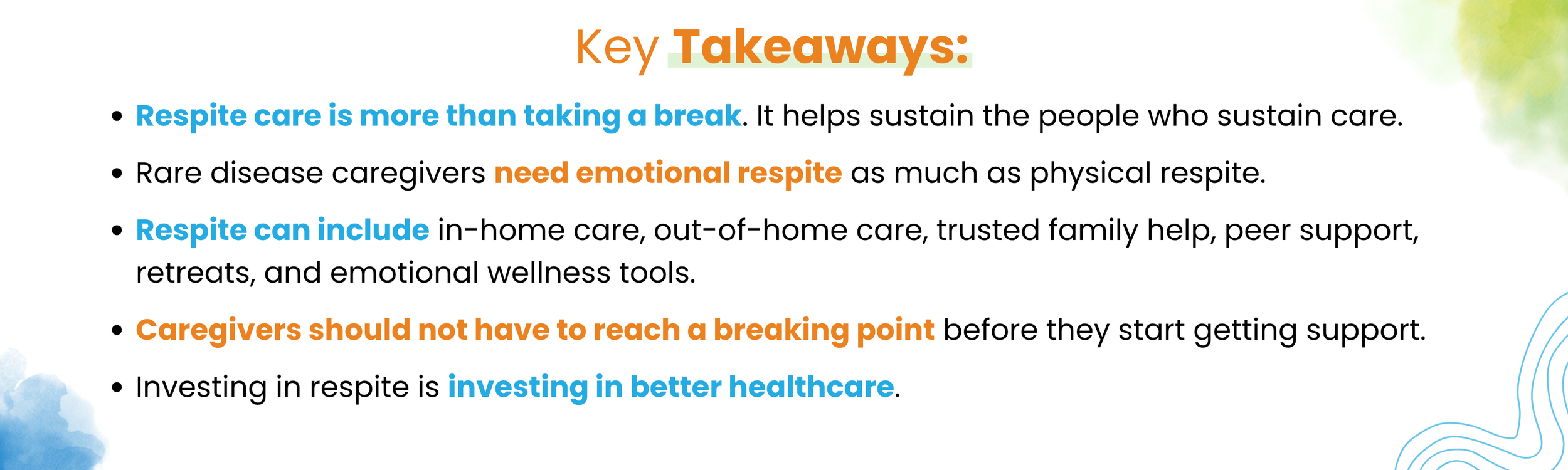
For rare disease families, respite care is part of sustainable caregiving. Relief can include rest, trusted community, emotional support, peer connection, retreats, and programs that help caregivers recharge through different stages of the journey.
Keep reading to learn what respite care means, why it matters in rare diseases, and how caregivers can find support even when traditional services are limited.
What Is Respite Care for Caregivers?
Respite care gives caregivers temporary relief from caregiving responsibilities while the person receiving care continues to be supported. It can last for a few hours, a full day, several days, or longer, depending on the family’s needs and available services.
According to the National Institute on Aging, respite care can happen at home, in a healthcare setting, or in an adult day care center. The main purpose is to give the primary caregiver time to rest, handle personal needs, or spend time away from caregiving duties.
But for many families, especially rare disease families, respite needs to mean something deeper. A caregiver may need physical rest, but they may also need emotional breathing room.
They may need time to process fear, grief, uncertainty, decision fatigue, or the pressure of always being responsible.
Why Rare Disease Families Need More Than Traditional Respite
Rare disease caregiving can be difficult because the care journey is often long, uncertain, and emotionally complex. You may be managing symptoms that change over time, searching for specialists, explaining the condition to others, coordinating appointments, and making decisions with limited information.
This can make traditional respite harder to access. Not every respite provider understands complex rare disease needs. Some families may feel nervous leaving their loved one with someone who doesn't understand their condition. Others may live in areas where trained respite services are not easy to find.
According to the Administration for Community Living, respite support is intended for family caregivers of children and adults across age groups, disabilities, and chronic conditions. That matters because respite isn’t only for older people. Families caring for children, teens, and adults with rare diseases may also need it.
Rare disease caregiving often asks families to carry extra burden, from medical, emotional, and logistical responsibilities at the same time. A break from these responsibilities can help, but it may not be enough if you return to the same isolation, stress, and uncertainty.
Emotional Respite Matters Too
Emotional respite means having space to step out of constant responsibility and feel supported as a person. It is not only about leaving the house or getting a few quiet hours. It is about having room to name what you’re carrying before the pressure becomes too heavy.
For one caregiver, emotional respite may look like joining a support group where others understand the rare disease journey. For another, it may look like attending a retreat, speaking with a counselor, or having a trusted person listen without trying to fix everything.
Emotional respite can help you pause, reflect, and feel less alone. It can also help you understand where you are in the caregiving journey, especially when stress has become so familiar that it feels normal.
Raregivers’ Interactive Emotional Journey Map supports this kind of reflection by helping caregivers recognize emotional stages and think about what support may be needed next.
The Different Types of Respite Care
Respite care can be different for every family. The following options will depend on your loved one’s needs, your comfort level, and the kind of relief you’re seeking.
1. In-Home Respite
In-home respite brings support at the exact spot where care already happens. A trained provider, nurse, aide, family member, or trusted person may help with supervision, daily routines, or care tasks while the primary caregiver rests.
2. Out-of-Home Respite
Out-of-home respite may happen through a care center, medical facility, day program, or short-term residential care option. It gives caregivers time away while their loved one receives support somewhere else.
3. Informal Respite
Informal respite can come from family members, friends, neighbors, faith communities, or trusted people in your support network. It may include help with errands, meals, school pickups, household tasks, or spending time with the person receiving care.
4. Peer and Community Respite
Peer and community support can give caregivers emotional relief through shared understanding. This may include online groups, caregiver circles, retreats, or nonprofit programs that create space for honest conversation.
5. Emotional Respite
Emotional respite helps caregivers process the emotional side of caregiving. It may include guided reflection, support groups, mental health care, retreats, or tools that help caregivers name stress before crisis begins.
Making Respite Part of Healthcare
Respite should not be treated as an extra benefit families receive only when things become unbearable. It should be part of how healthcare supports the whole caregiving system.
Caregivers help manage medications, appointments, records, symptoms, transitions, communication, and daily routines. When caregivers become depleted, the whole experience becomes harder to sustain.
Research suggests that consistent respite can reduce caregiver burden and improve outcomes for caregivers and families. Yet many caregivers never access formal respite services because of cost, long waitlists, limited availability, or simply not knowing what support is available.

Investing in respite is investing in better healthcare. Funders, retreat partners, nonprofit collaborators, and healthcare organizations can help build programs that make relief easier to access before a crisis begins.
How Caregivers Can Find Respite When Traditional Services Are Limited
Traditional respite isn’t always available, especially for families managing rare or complex conditions. But that doesn't mean support isn’t accessible.
You can start by asking your healthcare team, social worker, case manager, or disease-specific organization about local respite options. Some families may also find help through Medicaid waiver programs, nonprofit grants, community organizations, or condition-specific advocacy groups.
Finding trained respite care isn't always easy. While families explore longer-term options, support groups, caregiver retreats, trusted family networks, and peer communities can provide connection, encouragement, and moments to recharge.
You can also use our Downloadable Emotional Journey Map to reflect on where support is missing and what kind of relief would help most right now.
FAQ: Respite Care for Caregivers
Q: What is respite care for caregivers?
Respite care gives caregivers temporary relief from caregiving responsibilities while their loved one continues receiving support. It can happen at home, outside the home, through a care program, or through trusted community support.
Q: Why is respite important for rare disease caregivers?
Rare disease caregiving can involve medical uncertainty, long diagnostic journeys, complex care needs, and ongoing emotional stress. Respite gives caregivers space to rest, recover, and stay supported through a long journey.
Q: Is respite care only for older adults?
No. Respite care can support caregivers of children, teens, adults, and older adults. Families caring for someone with a disability, chronic illness, or rare disease may all need respite.
Q: What is emotional respite?
Emotional respite is support that helps caregivers process stress, grief, uncertainty, and emotional fatigue. It may include peer support, retreats, counseling, guided reflection, or caregiver wellness tools.
Q: How can caregivers find respite if services are not available nearby?
Caregivers can ask healthcare teams, social workers, disease-specific organizations, local nonprofits, and community groups about available support. When formal respite is limited, peer support, trusted family help, online groups, and caregiver retreats can still offer relief.
Relief Is Part of Care
Relief isn’t a reward caregivers earn after they have given everything. It is part of the whole process that makes caregiving sustainable.
For rare disease families, respite should include rest, emotional support, trusted community, and tools that help caregivers understand what they need through each stage of the journey.
And for funders, partners, and healthcare organizations, respite isn’t simply a family support service. It is healthcare infrastructure. When caregivers are supported, families are better able to keep moving through complex care with connection, readiness, and hope.
Connect with Raregivers to find caregiver support, retreats, and community programs designed to help you rest, reconnect, and keep going.
