
How Caregiver Stories Are Changing the Rare Disease Conversation
Rare disease advocacy often begins with numbers. Families hear statistics about delayed diagnoses, treatment barriers, and the millions of people affected globally. Those figures matter because they help increase visibility around conditions that are still widely misunderstood.
However, statistics rarely explain what caregiving actually feels like inside a family’s daily life.
According to Global Genes, 400 million people worldwide are affected by rare diseases. Even so, many caregivers still describe feeling invisible inside healthcare systems and public conversations because emotional realities are much harder to measure than medical outcomes.
Caregiving responsibilities often build quietly over time through appointments, advocacy work, interrupted sleep, emotional exhaustion, financial strain, and constant uncertainty about the future.
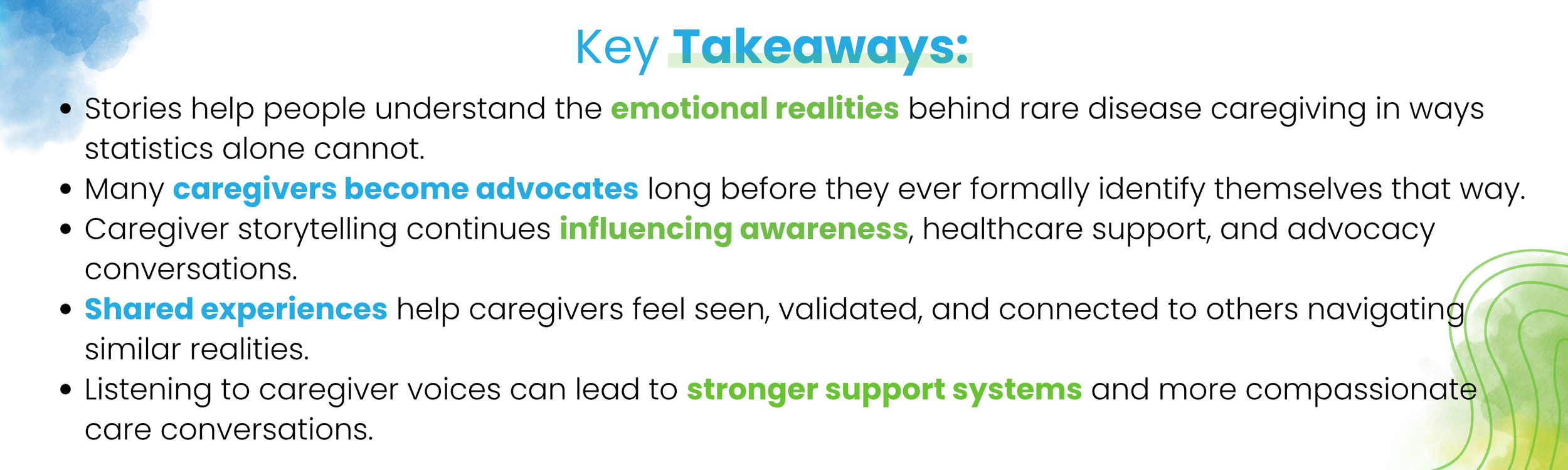
Caregiver storytelling is helping reshape advocacy, healthcare conversations, and emotional support across the rare disease community.
Why Stories Matter in Rare Disease Advocacy
Data creates awareness, but stories create emotional connection. People may understand a diagnosis intellectually, but personal experiences help them understand the emotional realities families carry behind that diagnosis.
Amanda Ross reflected on that emotional weight while discussing her experience caring for her mother with Posterior Cortical Atrophy, a rare form of dementia.
“Most people think grief is the biggest thing, and it is, but there is so much more...it’s the exhaustion that can overwhelm you,” Amanda shared while describing the emotional strain many caregivers quietly carry every day.
Her story reflects something many caregivers experience privately. Emotional exhaustion rarely comes from one isolated moment. Instead, it builds gradually through years of vigilance, advocacy, emotional support, and responsibility.
Stories like these continue strengthening the connection and visibility across the Raregivers community as more caregivers begin sharing the emotional realities behind rare disease care.
Stories help transform caregiving from an abstract concept into something emotionally recognizable.
Caregivers Become Advocates Because They Have To
Rare disease caregivers often become advocates long before they formally identify themselves that way. Many families enter healthcare systems without clear guidance, consistent support, or reliable answers.
Shari Bailey, whose daughter Laila lives with Jacobsen syndrome, described how unpredictability becomes part of daily life for many rare caregivers. “There is often no clear roadmap, no predictable path,” Shari explained while reflecting on the uncertainty families constantly navigate.
Her experience captures why so many caregivers move naturally into advocacy roles. Families frequently find themselves coordinating care, researching treatments, challenging insurance barriers, navigating educational systems, and searching for answers that are not easily available.
Advocacy often begins during moments of survival rather than intention.
Shari also spoke about the connection caregivers develop through shared understanding. “There is a quiet, unspoken bond between caregivers, especially those navigating rare diseases.”
That sense of connection matters deeply because many caregivers spend years feeling emotionally isolated inside responsibilities other people may never fully see.
How Caregiver Voices Are Driving Change
Stories often create ripple effects far beyond individual experiences. Personal experiences help people understand gaps within healthcare systems, accessibility challenges, and emotional realities that are often overlooked in public conversations.
Drew Ann Long’s experience caring for her daughter Caroline, who lives with Rett syndrome, eventually led to the creation of Caroline’s Cart, an accessibility innovation that changed shopping experiences for many families navigating disability and caregiving responsibilities.
“You become an expert in systems you never asked to learn,” Drew Ann explained while discussing how caregiving forces families to navigate unfamiliar systems constantly.
Caregiver storytelling continues helping:
Increase public awareness
Reduce stigma surrounding rare diseases
Help families feel less alone
Improve support systems
Influence healthcare and policy conversations
In addition, caregiver voices continue strengthening advocacy work as more families speak openly about the realities they navigate every day.
Stories often create momentum long before institutional systems fully respond.
Storytelling Is Changing How Healthcare Thinks About Support
Healthcare conversations are increasingly recognizing that caregiver wellbeing directly affects long-term care stability. Many caregivers continue functioning under enormous emotional pressure while receiving little structured emotional support themselves.
Nicole Notar spoke directly to that reality while discussing the role emotional support plays inside healthcare systems.
“Emotional support is not ‘extra’ care. It’s a core part of healthcare itself,” Nicole explained while reflecting on the gaps many caregivers experience inside traditional support structures.
Her perspective reflects a growing recognition across advocacy spaces that emotional well-being cannot be separated from care itself.
Storytelling is helping healthcare systems better understand the emotional side of caregiving because caregivers are speaking more openly about burnout, isolation, emotional fatigue, and the need for sustainable support.
What Happens When Caregiver Voices Go Unheard
Ignoring caregiver experiences creates consequences that extend far beyond emotional exhaustion alone. Many caregivers continue carrying overwhelming responsibilities while appearing outwardly functional to the people around them.
Bree Sharp described that progression with painful clarity. “The caregiver goes quiet. Not all at once — gradually,” Bree shared while discussing how emotional depletion changes both caregivers and the care they provide.
Suzanne Horton reflected on the consequences of delayed support after caring for her father. “Support for me did not show up until after he passed. But the reality is, I needed it when caregiving began five years earlier,” Suzanne explained while discussing how many caregivers only receive emotional support after reaching crisis points.
Emotional strain compounds slowly over time, especially when caregivers feel unsupported inside the very systems they depend on most.
Ignoring caregiver experiences affects entire care systems, not only individual families.
Caregivers Need Spaces Where They Feel Understood
Caregiving can become isolating, especially when families feel like nobody around them fully understands the emotional pressure they carry every day. Many caregivers spend years focusing entirely on survival while quietly suppressing their own exhaustion, grief, frustration, and fear.
When caregivers speak openly about those realities, other families begin recognizing parts of themselves in those stories. That recognition creates connection, validation, and reassurance that they are not carrying these responsibilities alone.
Amanda Ross later reflected on the emotional impact of sharing her story publicly. “It’s rewarding to feel seen and to know you are helping others,” Amanda shared while discussing the value of honest caregiver conversations.
Rare disease advocacy becomes stronger when caregivers feel heard, supported, and connected to one another.
Join our Raregivers Weekly Support Groups to connect with caregivers who understand the emotional realities, challenges, and resilience that shape rare disease caregiving every day.
If you or someone you know needs immediate emotional support, text RARE (EN) or RARAS (ES) to 741741 to connect with a trained Crisis Text Line counselor.
